

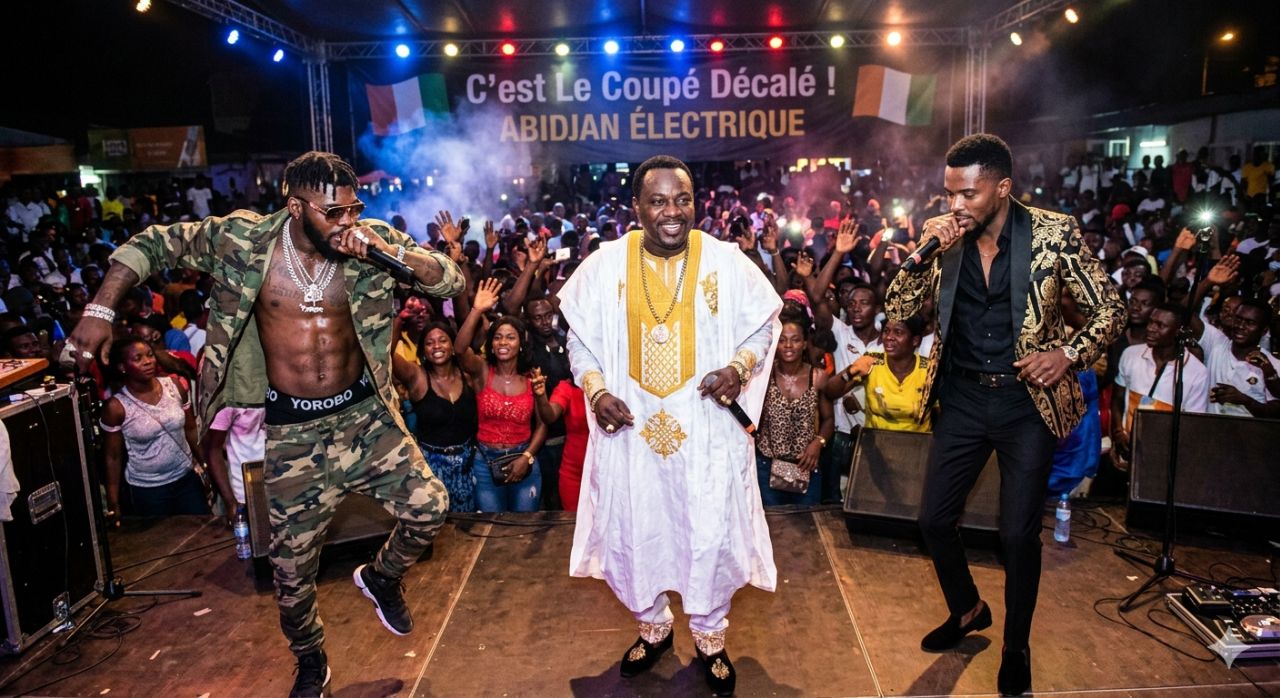
Coupé Décalé: The Ivorian Madness That Made All of Africa Dance
Picture Paris in the early 2000s. Somewhere inside an Afro-Parisian nightclub near the Quai d’Austerlitz, a handful of young Ivorians have decided that the best possible answer to the turmoil tearing their country apart is a party. Not just any party, a total, flamboyant, over-the-top celebration. Champagne flowing freely, banknotes raining down on the dancefloor, designer clothes, jewellery flashing under the strobe lights and a way of dancing like nothing anyone had seen before. Frenzied, insolent, sovereign.
These young men call themselves La Jet Set. Their leader is Douk Saga, known as le Président. And the movement they are building, they name Coupé Décalé.
Twenty years later, this Ivorian cry of joy still echoes across dancefloors throughout Francophone Africa. Coupé Décalé has survived everything: political crises, the loss of its greatest artists, changing musical trends. It is still here — vibrant, reinvented, indestructible. This is its story.
What Is Coupé Décalé? More Than a Genre, It’s a Way of Life
Before anything else, Coupé Décalé is a state of mind. Its name comes from nouchi, the Ivorian street slang spoken in the alleys of Abidjan and its etymological origins carry multiple readings. One popular version says that couper means to swindle and décaler means to flee. Another traces coupé back to the Attié town of Akoupé, in southeastern Ivory Coast, birthplace of one of the dance styles that helped forge the genre. Both readings coexist, and this founding ambiguity is part of the movement’s subversive charm.
Musically, Coupé Décalé is an African hybrid: it borrows its rhythmic foundations from Congolese ndombolo, weaves in bass guitar lines inherited from soukous, and progressively absorbs hip-hop, afrobeat, dancehall and electronic music across its different generations. What sets it apart from every other genre is its own vocabulary, social codes, culture of ostentatious celebration, and hundreds of named dance moves : the faro farot, the boucan, the décalé wolof, the tchintchin…
Coupé Décalé is music, dance, fashion, slang and a philosophy of life rolled into a single movement. An entire world.
The Origins: Paris 2002, A Party as Resistance
La Jet Set and the Birth of a Movement (2002)
In 2002, Ivory Coast was living through one of its darkest chapters. Following the 1999 coup d’état and violent elections in 2000, an armed rebellion erupted in September 2002, cutting the country in two. A strict curfew was imposed in Abidjan. Tension was everywhere.
In Paris, inside Afro-Parisian nightclubs, a group of young Ivorian diaspora members refused to be broken. They formed La Jet Set: Douk Saga, Le Molare, Lino Versace, Boro Sanguy, Solo Béton, Chacoule and their crew. Their response to tragedy was an excess of living : luxury clothing tailored close to the body, champagne bottles sent to DJs, wads of banknotes distributed on the dancefloor in the flamboyant gesture they called le travaillement (literally: “the working”).
One evening at Club l’Alyzée in Paris, Boro Sanguy improvised a new dance step, the coupé cloué, inspired by Congolese ndombolo and enriched with breakdancing, smurf and hip-hop moves. Douk Saga picked it up on the dancefloor, dancing it off-beat. At the decks, DJ Rams announced over the mic: “Douk Saga is coming through with his coupé-décalé.” The name was born almost by accident.
“Sagacité”: The Founding Anthem (2003)
Producer David Monsoh saw the extraordinary commercial potential in the movement. He persuaded Douk Saga to enter the studio and put the Sagacité philosophy to music. In 2003, “Sagacité” was released, the first great Coupé Décalé hit. The music video, shot in Paris with the Eiffel Tower in the background, codified the entire visual spirit of the movement: the bling-bling outfits, the champagne, the travaillement, the faro farot, the frantic dancing.
The song was a tidal wave. A Sagacité caravan toured across Ivory Coast in 2003, in spite of the curfew and the war. In the maquis bars of Abidjan and the daytime clubs Ivorians frequented because the nights were under lockdown, Coupé Décalé exploded. The music arrived like a breath of oxygen into a suffocating country.
For young Ivorians, Douk Saga’s message was clear: even in the middle of the storm, you can dance. Even with nothing, you can dream that you have everything. Even broken, you can be a king for one night.
The Conquest of West Africa (2004–2007)
Between 2004 and 2007, Coupé Décalé swept across Francophone West Africa at breathtaking speed. Ivorian DJs were invited everywhere to Burkina Faso, Senegal, Mali, Togo, Benin. Artists from across the region adopted the genre, infusing it with their own local sounds. African radio stations and TV channels played the clips on loop. Dance moves spread into schoolyards and wedding receptions.
French rappers with African roots discovered the genre. Zouk, rock and reggae artists tried their hand at it. Coupé Décalé had outgrown its Ivorian cradle entirely.
Then, in October 2006, Douk Saga passed away in Ouagadougou at just 32 years old. Musical Africa mourned le Président. But the movement did not stop, it entered a new era.
The Golden Age: The DJ Arafat Years (2008–2019)
DJ Arafat: “The Daïshi” Reinvents the Genre
After Douk Saga’s passing, Coupé Décalé could have faded. But no one had told Ange Didier Huon, known as DJ Arafat, an artistic tornado who would not only save the genre but launch it to new heights.
Born in Abidjan, DJ Arafat, nicknamed le Daïshi (a Lingala term meaning “the dead one”, because he claimed to be musically dead in order to kill the competition) was an extraordinary personality. Relentlessly energetic and endlessly creative, he modernised Coupé Décalé by opening it up to Nigerian afrobeat, Jamaican dancehall and electronic sounds while preserving the original spirit of celebration and defiance.
His collaborations stretched across the continent: Davido (Nigeria), Toofan (Togo), Fally Ipupa (DR Congo), J-Martins (Nigeria). In 2012, he stormed the French market with “Oulala” and won both the Best African Artist and Best Male West African Artist awards at the Kora Awards, a true continental coronation.
With his legendary dancers (Bébé Sans OS, Magicien Usher, Ordinateur) his shows became total spectacles, events that people never forgot. His fans, whom he affectionately called les Chinois, showed him absolute devotion.
In August 2019, DJ Arafat died in a motorcycle accident in Abidjan. He was 33. The outpouring of grief was immense, hundreds of thousands attended his funeral. In him, Coupé Décalé lost its greatest second-generation ambassador.
Serge Beynaud: The Master of the Popular Formula
While DJ Arafat electrified crowds with raw energy, Serge Beynaud was quietly building one of the most impressive track records in Coupé Décalé history.
Winner of the Primud d’Or 2018, Ivory Coast’s highest musical honour, Serge Beynaud made the genre accessible to every generation. His music is festive, inclusive, deeply optimistic. Tracks like “Kointabala”, “Débrouiller Débrouiller” and “Kota na Koto” (over 4 million views) crossed Ivorian borders to reach the entire subregion.
His ability to fuse Coupé Décalé with afropop and afrotrap makes him a natural bridge between generations. Today, he embodies the power of lasting reinvention in a genre that never stops evolving.
The Third Generation: Ivory Coast’s New Wave
Safarel Obiang : The Revolutionary Choreographer
Safarel Obiang represents the generation that grew up with Coupé Décalé as its soundtrack. His biggest musical invention is the tchintchin, a viral, explosive, instantly recognisable dance move that accumulated over 6 million YouTube views and took hold on dancefloors across Africa and its diaspora.
In 2020, he presented the tchintchin at an urban music festival in Brussels, captivating an international audience, proof that Coupé Décalé can still surprise and conquer new ground.
Kerozen : Faith and Resilience
Kerozen embodies a spiritual and uplifting dimension of Coupé Décalé. Tracks like “Dieu Sur Terre” (God on Earth) and “Tu Seras Élevé” (You Will Be Elevated) bring an inspirational depth rarely found in dance music, reaching audiences who look to festive music for messages of resilience and hope. He proves that Coupé Décalé can be both a dance and a prayer.
Ariel Sheney : The Speed of Lightning
Ariel Sheney is the artist of velocity. His music video releases accumulate millions of views in days, his personal record of 1 million views in 4 days for “Amina” illustrates his extraordinary ability to connect with audiences instantly. Versatile and genre-fluid, he explores the boundaries between Coupé Décalé, afropop and urban music with effortless confidence.
The Women of Coupé Décalé
The genre has its queens too. Teeyah was the pioneering woman in Coupé Décalé. Claire Bahi brings a distinct vocal elegance. Vitale, Bamba Ami Sarah and Sandia Chouchou expand the genre’s spectrum, proving that the energy of Coupé Décalé belongs to no single gender or category.
The Iconic African Videos You Have to Watch
🎬 “Sagacité” — Douk Saga (2003)
The founding video. Shot between Paris streets and the Eiffel Tower, this clip is the visual manifesto of the Coupé Décalé movement in its purest original form: designer outfits, flying banknotes, frantic dancing, nouchi slang. More than twenty years later, watching this video is like travelling back to the very source of an entire era of Francophone African musical culture.
🎬 “Boucan” — Le Molare (2004)
Le Molare, co-founder of the Jet Set, delivered one of the first-generation’s anthems with this track. The décalé wolof dance he popularised here swept across West Africa within weeks. A video-document of a defining era.
🎬 “Oulala” — DJ Arafat (2012)
The video of French conquest. With Oulala, DJ Arafat brought Coupé Décalé into clubs across France and cemented his status as the genre’s greatest export. His overflowing energy, spectacular dancing and screen charisma make this one of the most-shared Ivorian clips of his generation.
🎬 “Kointabala” — Serge Beynaud
A timeless classic from Serge Beynaud’s catalogue, played on loop on African radio stations and at family celebrations across Francophone West Africa. The track that made him the people’s king of Coupé Décalé — accessible, joyful, irresistible.
🎬 “Tchintchin” — Safarel Obiang
The new generation’s defining video. With over 6 million views, Tchintchin proves that Coupé Décalé is not nostalgic — it is alive, creative, capable of inventing fresh codes decade after decade. The signature dance move in the video has been replicated in dozens of countries.
🎬 “Lékilé” — DJ Arafat
An absolute hit that surpassed one million views in under a month. Lékilé is perhaps the most perfect demonstration of what DJ Arafat was at the height of his powers: an unstoppable dance production, a unique vocal charisma, a staging that leaves nobody standing still.
Coupé Décalé Across Africa: A Shared Heritage
Born in the Ivorian diaspora in France, Coupé Décalé has become over two decades one of the most unifying genres in Francophone Africa. From Burkina Faso to Senegal, from Mali to Benin, from the Democratic Republic of Congo to Cameroon, everywhere it took root, hybridised with local sounds, and produced unique variations while never losing its Ivorian DNA.
The footballer Didier Drogba popularised Coupé Décalé dance moves during his goal celebrations before millions of television viewers worldwide, a sign that the genre transcends its musical context to become a broader African identity marker.
In France, Belgium, Canada and Switzerland, in every city where the Francophone African diaspora lives, Coupé Décalé is present at parties, weddings and cultural associations. It is the thread connecting Africans on the continent to their brothers and sisters in the diaspora.
And French-Guinean rapper MHD, prince of Afro-trap, paid explicit tribute to the movement in his clip Sagacité from the album Mansa, proving that the movement continues to irrigate new generations of African urban music in Europe.
Why Coupé Décalé Belongs to All of Us
There is something deeply political about Coupé Décalé even if it doesn’t appear that way at first glance. This genre was born during a war. It chose celebration as its answer to fear. It took the codes of luxury and success and placed them in the hands of a young African generation that had neither, just an insolent, irrepressible desire to live.
The travaillement, distributing banknotes in a club, may look like pure extravagance. But it carries within it a philosophy of redistribution, generosity and shared joy. Coupé Décalé says: even when you have nothing, you can give. Even in a crisis, you can be the king of your night.
This pan-African philosophy is why the genre transcends time and borders. It does not age, it reinvents. It does not limit itself, it opens up. It does not mourn, it dances.
Coupé Décalé on Afro Video: The Best Selection of Ivorian Music Videos
On Afro Video, discover the finest collection of Coupé Décalé music videos, from the Jet Set pioneers to today’s rising stars. From the classics that wrote history to the recent titles writing the genre’s future. Whether you are a lifelong fan or discovering the movement for the very first time, our catalogue gives you the very best of Ivorian musical heritage.
Because Africa dances. And from Abidjan to Paris, from Dakar to Brussels, it dances to Coupé Décalé.
🎵 Watch all Coupé Décalé videos and explore many more African music genres on Afro Video — your dedicated platform for the best African music videos.