

Mapouka: A Journey to the Roots of a Traditional Ivorian Dance
About sixty kilometres from Abidjan, there is a small fishing village of barely 3,000 inhabitants, nestled between white sand and the calm waters of the Ébrié Lagoon. This village is called Nigui-Saff. Few people outside Ivory Coast know its name. And yet, it is from this exact place — quiet, luminous — that one of West Africa’s most discussed, and most misunderstood, cultural movements was born: Mapouka.
Too often reduced to its most superficial distortions, Mapouka deserves to be given back what truly belongs to it: a history, a people, a symbolism, a heritage. This is the story we tell here.
Mapouka: A Dance of the Aïzi People, Rooted in Southeastern Ivory Coast
Mapouka is a traditional dance originating from the lagoon region of southeastern Ivory Coast, a vast landscape of mangroves, lagoons and fishing villages stretching around Jacqueville, Grand-Lahou and Dabou. This region is the historic home of several related lagoon peoples — the Aïzi (or Ahizi), the Avikam, and the Alladian — whose cultures, languages and dance practices share common roots.
It is specifically within the Aïzi community, and more precisely in the village of Nigui-Saff, that Mapouka finds its most directly documented origin. This village, facing the Ébrié Lagoon and administratively part of Jacqueville, is considered by historians and practitioners alike to be the birthplace of modern Mapouka.
What Does the Word “Mapouka” Mean?
Contrary to what one might assume, the name Mapouka carries nothing exotic or mysterious in its original meaning. It is a contraction of the expression “Mapouka-té,” which in the Ahizi language means “to cover” or “to secure.” According to local oral tradition, this meaning carries a playful warning: anyone about to dance the Mapouka is advised to first settle their everyday affairs, so powerfully captivating is this rhythm once it takes hold.
This etymology, passed down notably by Dr Pitté Albert, a son of Nigui-Saff and historical promoter of the group Nigui-Saff K. Dance, reminds us that Mapouka is, above all, an experience of collective communion — a moment when the whole village comes together and ordinary time seems to pause.
Origins and Historical Context: From Ahoussi to Mapouka (1988)
The documented history of modern Mapouka begins in 1988. At that time, a festive rhythm called Ahoussi, imported from the Grand-Lahou region, was circulating through the lagoon villages. Ahoussi is a celebratory dance, performed notably during ceremonies where women, adorned in their finest attire with a wrapper tied at the waist, entered the dance circle with confidence and determination — a powerful social gesture affirming their place and dignity within the community.
It was a man from Nigui-Saff, Avié Emmanuel, a gendarme by profession, who transformed this choreography in 1988. Watching his own daughter dance the Ahoussi, he had the idea of keeping the upper body — hips and pelvis — still, letting only the lower body’s muscles vibrate in perfect synchronisation with the syncopated drum rhythm. Pleased with the result, he shared it, and soon the entire village adopted this new way of dancing.
Built on this rhythmic foundation — two drums, castanets, bells — songs emerged addressing themes of everyday life, encouragement to work, and humility. A first group formed: “Ambiance facile de Nigui-Saff.” It soon began performing at celebrations in Jacqueville, Bouaké, and Grand-Bassam — Mapouka’s journey had begun.
The Consecration: Nigui-Saff K. Dance and the 1999 Koras
In 1998, under the leadership of Dr Pitté Albert, the founding group officially recorded its work and took the name Nigui-Saff K. Dance. Backed by an entire village, an entire community proud of its heritage, the group was soon invited to perform on the continental stage. The high point of this recognition came in 1999: Nigui-Saff K. Dance was selected for the final rounds of the Kora Awards in South Africa, where the group was crowned Best Traditional Dance Group before an audience of nearly 300 million television viewers worldwide.
This achievement is essential to understanding Mapouka in its truest form: long before becoming a media controversy, it was a source of Ivorian national pride, recognised and celebrated on the most prestigious African music stage of its time.
The Symbolic Meaning of Mapouka: Fertility, Resilience and Feminine Power
Beyond its historical narrative, Mapouka carries a profound symbolic weight, rooted in the cosmologies of the lagoon peoples of southern Ivory Coast.
A Feminine Body Language
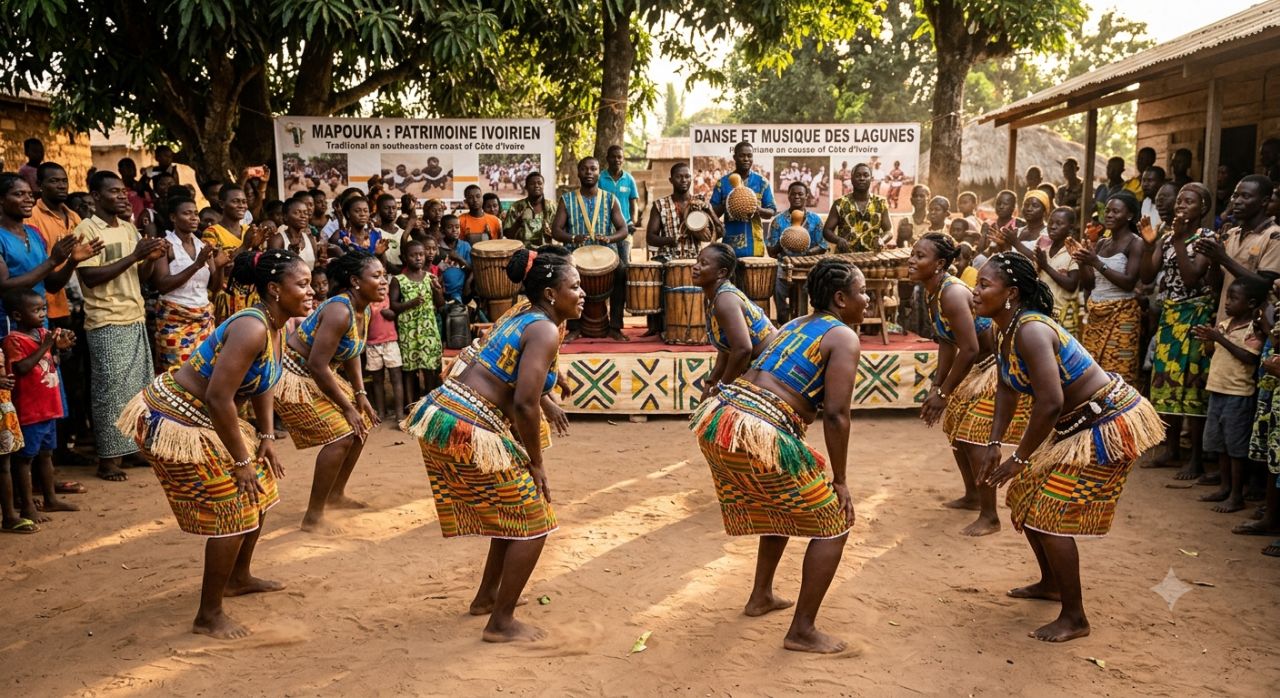
Within the Aïzi, Avikam and Alladian communities, traditional dance embodies above all feminine power and fertility. Through precise, codified movements, the dancer’s body becomes a genuine language — a way of affirming and celebrating women’s essential role in the continuity of social, family and community life. Far from being mere entertainment, traditional dance allows women a form of agency and social recognition within community structures that are sometimes strictly organised.
The Echo of the Lagoons and Fishing Life
Among the lagoon communities of southeastern Ivory Coast, Mapouka’s vigorous, rhythmic movements are also rooted in daily life: according to certain oral traditions, they evoke the rhythmic struggle of fish caught in nets — an image celebrating the ocean’s abundance and a successful catch, both vital to these coastal communities. The dancer thus embodies a form of nurturing strength, much like the ocean itself: generous yet demanding, powerful yet essential to life.
A Dance of Resilience
These layered symbolisms — fertility, abundance, resilience in the face of nature’s and the sea’s unpredictability — root Mapouka within a much broader tradition of West African dances where bodily movement expresses the generative forces of life itself. Understanding this dimension means understanding that Mapouka, in its essence, is a ritual and communal art form on par with so many other choreographic traditions across the continent.
From Tradition to the City: The Story of a Cultural Migration
Like many West African cultural practices, Mapouka experienced a trajectory shaped by rural-to-urban migration toward Abidjan from the 1980s onward. Moving from village ceremonies to the urban stages of Ivory Coast’s economic capital, the dance inevitably encountered new influences, new audiences, and a rapidly expanding entertainment industry.
It was within this urban context that numerous groups multiplied around the turn of the 2000s, each offering its own interpretation of the original choreography. This period also saw Mapouka cross Ivorian borders to reach Cameroon, Togo, Burkina Faso, Senegal, and African diaspora communities in Europe — a spread that reflects the powerful appeal of this unique rhythmic heritage.
For anyone genuinely interested in Ivorian culture, it is important to distinguish the original traditional dance — that of Nigui-Saff, of village ceremonies, of Dr Pitté Albert and his community — from the many commercial variations that, over time and through online distribution, drifted considerably from this authentic cultural heritage. It is precisely this confusion that this article seeks to clear up: restoring to Mapouka its rightful place as an Ivorian choreographic heritage worthy of study, respect and transmission.
Mapouka Today: A Heritage Worth Preserving
Today, in the lagoon villages of southeastern Ivory Coast, Mapouka continues to be danced during traditional ceremonies, village festivals, weddings and community celebrations. Cultural associations, researchers and enthusiasts — reflected in recent academic work published on Mapouka’s origins and strategies for preserving this traditional dance — are actively working to document, transmit and secure recognition for this heritage as what it truly is: a living cultural expression of Ivorian creative genius.
Youssoumba, the traditional musical genre that has historically accompanied Mapouka — blending drums, rhythmic bottles, solo vocals and choir — remains an important part of this sonic heritage, one worth preserving and introducing to new generations.
Why This Story Deserves to Be Told
At a time when a simple online search can reduce decades of culture to a handful of distorted clichés, we believe it is essential, here on Afro Video, to restore depth and context to this heritage. Mapouka was not born out of controversy: it was born in a small fishing village on the shores of the Ébrié Lagoon, carried forward by a proud community, documented by researchers, and celebrated on the African music stage.
Understanding Mapouka for what it truly is — a dance of the Aïzi people, an expression of fertility and resilience, a village art form that became a source of national pride — is a way of doing justice to one of the many choreographic treasures found within Ivory Coast’s cultural heritage, and more broadly, within West Africa’s.
Ivorian Heritage on Afro Video
At Afro Video, we are committed to documenting and celebrating the authentic richness of African musical and choreographic traditions. Mapouka, understood in its true cultural context, is part of this heritage we are proud to help our pan-African community discover and rediscover.
Because every dance carries a story. And every story deserves to be told with accuracy.
🎵 Discover Africa’s musical and choreographic heritage on Afro Video — your dedicated platform for the best African music videos.