


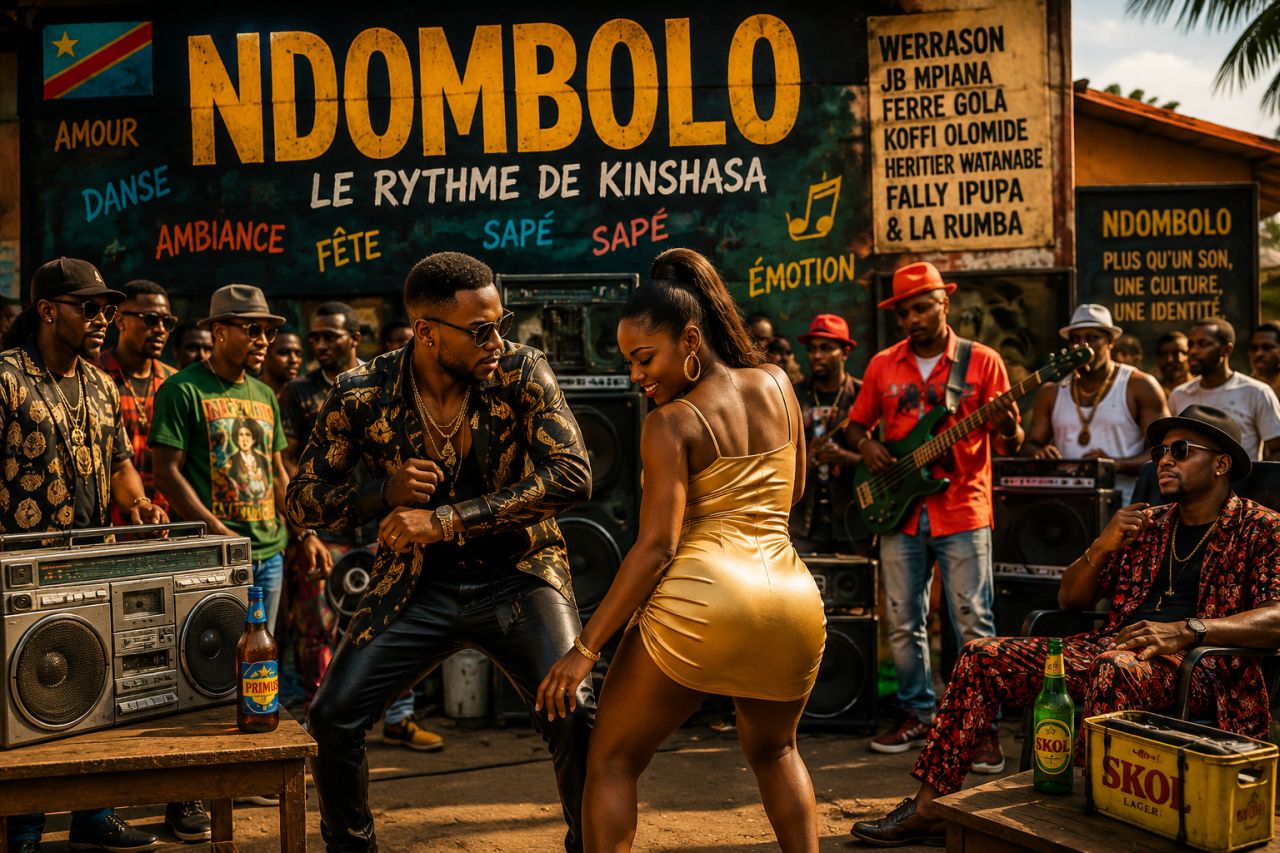
Ndombolo: The Kinshasa Cry That Shook Dancefloors Across Africa
There is a single cry in Congolese music that, on its own, can send an entire crowd leaping onto the dancefloor. A cry delivered with a powerful, almost warrior-like voice, announcing that things are about to get serious: “Ndombolo!” The moment it’s launched, the guitars speed up, the percussion cracks, hips start moving — and an entire continent rises to its feet.
Born in the working-class neighbourhoods of Kinshasa at the dawn of the 1990s, Ndombolo is far more than just a dance. It is the flamboyant heir of Congolese rumba — the bridge between Africa’s most respected musical tradition and a young generation that wanted to dance faster, louder, freer. For more than thirty years, it has continued to electrify dancefloors from Kinshasa to Paris, from Brazzaville to Brussels, from Libreville to Guadeloupe.
What Is Ndombolo? Rumba That Started Running
To understand Ndombolo, you first need to understand its father: Congolese rumba. Born in the late 1930s in Congo, this genre blends Afro-Cuban rhythms with Lingala vocals, sung with incomparable elegance and tenderness by legends like Papa Wemba and Franco Luambo. Rumba is slow, romantic, glorifying — a music for love and memory.
But by the late 1980s, in the wake of the group Zaïko Langa Langa and its founding rhythm, the cavacha, a new generation of Kinshasa musicians felt the need to speed things up. They kept rumba’s soul — its virtuoso solo guitars, its sung Lingala — but added faster percussion, synthesized sounds, and above all: a sharper, more demonstrative, more festive dance.
This accelerated section of a song — known as the sebene — gradually grew into a genre of its own. It became known as Ndombolo.
The word itself carries a fun and disputed history: some link it to cannabis slang, others to a hip movement (popularly translated as a description of hip-shaking dance moves), and its exact origin remains debated between rival Kinshasa groups. What is certain is that the word — and the cry that accompanies it — became, within a single decade, one of the most recognisable sonic symbols across the entire African continent.
The History of Ndombolo: From Kinshasa to the World
The Roots: Zaïko Langa Langa and the Cavacha (Late 1980s)
It all begins with Zaïko Langa Langa, the revolutionary group of modern Congolese music. Led by young musicians barely in their twenties — Papa Wemba, Evoloko, Pepe Felly — Zaïko invented the cavacha, a syncopated drum rhythm that would become the rhythmic foundation of all dance-oriented Congolese music to come. Every rhythmic innovation from Zaïko came paired with a new dance: the cavacha tambour, the kwempa kwempa, the wondostock…
This constant creative ferment laid the groundwork for what would become Ndombolo.
The Founding Cry: Tutu Caludji and Wenge Musica (1995)
History credits one specific name for the original cry that gave the genre its name: Tutu Caludji, an atalaku (chanter-animator) within the group Wenge Musica BCBG 4×4. His cry, “Ndombolo!”, delivered with unprecedented energy, became the sonic signature that would define an entire generation.
The dance itself was a collective creation: Werrason and JB Mpiana, future legendary leaders, added spinning movements and hand gestures. According to several accounts, the choreography was definitively set during a memorable rehearsal at Samba Playa in Kinshasa in May 1995, under the blazing Congolese sun.
Wenge Musica, alongside Zaïko Langa Langa before it, became the most decisive group in the genre’s birth. For ten years, the group made all of Africa — and its diaspora — dance.
The Continental Explosion: The Late 1990s
In 1997, JB Mpiana released the album Feux de l’Amour, which contained an eponymous track named Ndombolo — a festive beat that became a phenomenon, setting nightclubs ablaze across Africa and Europe. That same year, Koffi Olomidé — already famous as Papa Wemba’s lyricist — released Loi, from the album Droit de Veto, a ndombolo anthem that remains one of the most internationally played tracks of the genre to this day.
This marked the start of the genre’s golden age. Bands multiplied and competed in a constant wave of creative energy: Werrason with his orchestra Wenge Musica Maison Mère, JB Mpiana with Wenge BCBG, Extra Musica in Brazzaville (led by Roga-Roga), Big Stars with Général Defao, and many more. Every new album release became a continental event.
The genre quickly spread beyond Congo-Kinshasa, taking firm root in Congo-Brazzaville, where Extra Musica became one of its most creative ambassadors — notably with their cult track “État-Major”.
International Recognition and the New Generation (2000s–Today)
In the 2000s, Ndombolo definitively crossed Congolese borders. Awilo Longomba massively popularised it across Europe and the Caribbean. The genre was adopted by artists from Ivory Coast, Cameroon and even South Africa, and directly inspired the birth of Ivorian Coupé Décalé — clear evidence of Kinshasa’s musical influence across the entire continent.
In the French Caribbean — Guadeloupe and Martinique — Ndombolo found a devoted audience that made it one of the most-played party genres at celebrations and weddings.
Today, Fally Ipupa, a former member of Koffi Olomidé’s Quartier Latin, embodies the new generation with an elegance that blends Ndombolo, rumba, and global urban sounds. In May 2026, he reached a historic milestone by performing two nights at the Stade de France — the ultimate consecration for a Congolese artist on the world stage. Ferre Gola completes this new wave with a voice of rare power, carrying forward the legacy of Koffi Olomidé, with whom he was once a close collaborator.
The African Artists Who Defined Ndombolo
Koffi Olomidé — The Emperor of Congolese Music 👑
A brilliant lyricist before becoming a solo artist, Koffi Olomidé is one of the most prolific and controversial figures in Congolese music. Founder of tchatcho (a fusion of rumba and modern urban influences) and Ngubette, he led his group Quartier Latin to the top of the African music scene for decades. His album Droit de Veto (1997) and the track Loi remain absolute reference points of the genre, still played today at Congolese gatherings worldwide.
Werrason — The King of the Forest 🦁
Leader of Wenge Musica Maison Mère, Werrason is nicknamed the King of the Forest in reference to the power and density of his musical productions. His albums Tindika Lokito and Solola Bien are pillars of the Ndombolo repertoire. His contribution to the genre’s original choreography, alongside JB Mpiana, makes him one of the founding architects of the dance itself.
JB Mpiana — The Sovereign
JB Mpiana, nicknamed Souverain 1er, is the other great leader to emerge from the historic split of Wenge Musica. With his group Wenge BCBG, he released Feux de l’Amour in 1997, containing the founding track that officially gave the genre its name. His influence on the modern structuring of Ndombolo is immense and undeniable.
Fally Ipupa — The World Ambassador of Modern Rumba
Trained in Koffi Olomidé’s Quartier Latin orchestra, Fally Ipupa went on to become the most-streamed Congolese solo artist of the 2020s in Francophone Africa. His albums Tokooos and Control are both certified Diamond. His track “Eloko Oyo” (2017), based on a traditional melody from the Mongo ethnic group, has surpassed 55 million views on YouTube, making it his most-watched video ever. In May 2026, two historic concerts at the Stade de France confirmed his status as a global superstar of Congolese music.
Roga-Roga & Extra Musica — The Ambassadors of Brazzaville
In Brazzaville, Extra Musica, led by Roga-Roga, made a major contribution to Ndombolo’s international reach, proving the genre belongs not only to Kinshasa but to the entire two-Congos region.
Ferre Gola — The Golden Voice of the New Generation
A former close collaborator of Koffi Olomidé, Ferre Gola has established himself as one of the most powerful and respected voices in contemporary rumba and Ndombolo, carrying the genre’s legacy to new generations of listeners.
The Iconic African Videos You Have to Watch
🎬 “Ndombolo” — JB Mpiana (1997, from Feux de l’Amour)
The founding track that officially gave the genre its name. Played non-stop in clubs across Africa and Europe upon release, this song captures the pure energy of an entire musical movement being born.
🎬 “Loi” — Koffi Olomidé (from Droit de Veto, 1997)
The most internationally played anthem since 1997. Nearly thirty years after its release, this track remains an essential staple, played at every Congolese diaspora celebration.
🎬 “État-Major” — Extra Musica
The cult track from the Brazzaville scene. A showcase of Congo-Brazzaville’s version of ndombolo energy, carried by Roga-Roga’s irresistible charisma.
🎬 “Eloko Oyo” — Fally Ipupa (2017)
The most-watched video in Fally Ipupa’s entire career, with over 55 million views. Based on a traditional Mongo melody, this track shows modern Ndombolo’s ability to draw on heritage to create a global hit.
🎬 “Mannequin” — Fally Ipupa feat. Naza & KeBlack
The collaboration that launched Fally Ipupa onto the French and international scene. A successful fusion of Congolese rumba and urban afropop.
🎬 “Solola Bien” — Werrason
A classic from the King of the Forest, showcasing the density and power of Wenge Musica Maison Mère productions at their peak.
Ndombolo Across Africa: A Living Heritage
Born in Kinshasa, Ndombolo never stayed confined within its original borders. In Congo-Brazzaville, it became a second musical language thanks to Extra Musica. In Cameroon, Gabon and Angola — across Central Africa — the genre became an essential festive reference point.
Even more remarkably: Ndombolo directly inspired the birth of Ivorian Coupé Décalé, striking proof of Kinshasa’s musical influence across all of Francophone West Africa. The genre’s signature Congolese solo guitars can be heard today in productions by French diaspora artists like Dadju (Mafuzzy Style), Naza (Sac à dos), and Belgian rapper Damso (Même Issue).
In Guadeloupe and Martinique, Ndombolo became one of the most popular party genres at family celebrations and weddings — an unbroken musical bridge between Central Africa and the French Caribbean.
In Geneva, the Brazzaville cultural centre has hosted, since the 2020s, the association Les Ambianceurs: Rumba Congolaise, dedicated to preserving and passing on this musical heritage — proof that the Congolese diaspora in Europe actively safeguards this legacy.
Why Ndombolo Has Moved Us for Three Decades
Ndombolo is, above all, about collective transmission. Unlike many modern genres born from a single artist or isolated innovation, Ndombolo was built step by step, generation after generation — from Zaïko Langa Langa’s cavacha to Tutu Caludji’s cry, from Werrason’s spinning moves to Fally Ipupa’s reinvented traditional melodies.
It is music that honours its roots — Congolese rumba, itself the heir of a centuries-old dialogue between Central Africa and Cuba — while constantly reinventing itself to stay relevant. The atalaku, the chanter-animator who launches the cries and vocal calls over percussion rhythms, embodies an essential griot-like function: celebrating, dedicating, glorifying, keeping collective memory alive through music.
Dancing Ndombolo means reconnecting with a musical lineage that spans nearly a century of Congolese history — from 1930s rumba to Fally Ipupa’s latest hits at the Stade de France.
Ndombolo on Afro Video: Explore the Best of Congolese Music
On Afro Video, discover the finest Ndombolo music videos curated by our editorial team — from historic founders to contemporary superstars. From legendary tracks that wrote Congolese music history to the latest hits still electrifying Kinshasa and its global diaspora.
Because Congo has been dancing for three decades. And all of Africa dances along with it.
🎵 Watch all Ndombolo videos and explore many more African music genres on Afro Video — your dedicated platform for the best African music videos.
